Weight management
Physician-supervised weight care in Upland — a real medical workup, honest expectations, and treatment that fits your body rather than a package you buy.
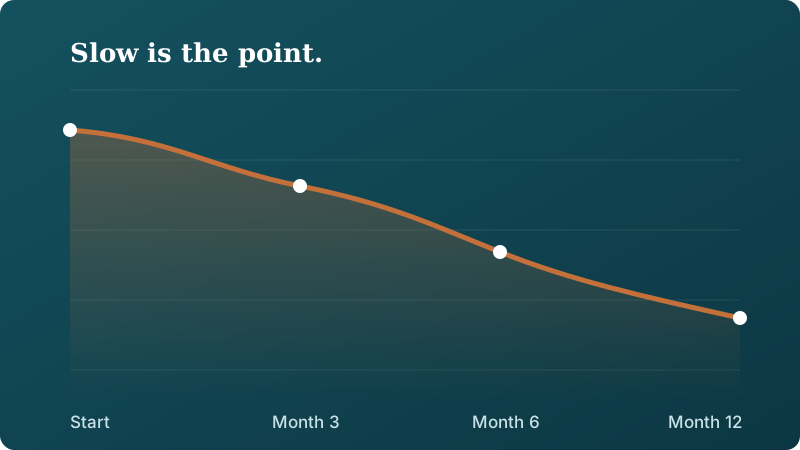
Why most weight programs fail you
Most of what is sold as weight loss is sold by people who are not physicians, cannot order labs, cannot review your medications, and have no way to tell whether the reason the scale will not move is your thyroid, your antidepressant, your sleep apnea, or your insulin resistance. They sell you the same protocol they sell everyone.
Weight is a medical problem with medical causes, and it deserves the same workup you would get for chest pain. That is what happens here.
What the first visit actually involves
- A full history — what you have already tried, what happened, and what made it stop working
- Labs — thyroid, A1c and fasting insulin, lipids, liver function, and testosterone or other hormones where relevant, at my wholesale cost
- A medication review — several common prescriptions cause steady weight gain, and swapping one is sometimes the whole intervention
- Screening for what is underneath — sleep apnea, PCOS, hypothyroidism, and the metabolic changes that come before diabetes
- A plan you had a say in — built around how you actually eat, work, and sleep
Ozempic, Mounjaro, and what they actually do
For most patients here, a GLP-1 medication is the core of the plan, paired with changes to how you eat and move. These are the drugs that changed what is medically possible in weight care, and I use them because they work — not because they are in the news.
Two molecules do most of the work. Each is sold under one name for diabetes and another for weight:
| Molecule | For diabetes | For weight | How it is given |
|---|---|---|---|
| Semaglutide | Ozempic | Wegovy | Weekly injection (a daily pill is now approved too) |
| Tirzepatide | Mounjaro | Zepbound | Weekly injection |
How much weight? In the head-to-head trial that compared them directly, tirzepatide produced about 20% average body-weight loss and semaglutide about 14% over roughly 16 months. Those are averages across thousands of people. Some lose considerably more, some noticeably less, and nobody can tell you in advance which you will be.
What about retatrutide?
Retatrutide is the next drug in this line — a weekly injection from Eli Lilly that acts on three hormone receptors (GIP, GLP-1 and glucagon) instead of one or two. The results so far are the strongest yet: in phase 3 trials reported in 2026, people on the highest dose lost on average about 21% to 23% of their body weight over 80 weeks.
It is not FDA-approved yet. Lilly plans to submit it to the FDA in early 2027, and until it is approved it is available only to people enrolled in clinical trials. Anything sold as retatrutide today — online, as a “research peptide,” or by a clinic — is not the tested, regulated drug, and you have no way of knowing what is in the vial. Once it is approved, I will be able to prescribe it here. Until then, tirzepatide and semaglutide are excellent, proven options, and I am happy to talk through where retatrutide may fit for you.
What happens at your first visit
You do not leave with a vague plan and an appointment in three months. In one visit I can usually get you started:
- A real evaluation — history, exam, and the labs that tell me whether something treatable is driving the weight
- A target that means something — not a dress size, but a number tied to your blood pressure, blood sugar, joints, and sleep, with a realistic timeline attached
- Honest expectations — what the first eight weeks feel like, what the scale will and will not do, and when to change course
- A prescription the same day when it is medically appropriate and you want to proceed
- Titration handled between visits — dose changes are the part that needs a physician who answers, which is why members do better here
The parts nobody advertises
- Side effects are real. Nausea, constipation, diarrhea, and reflux are common, especially while the dose is climbing. Most settle. Some do not, and then I change something.
- They are not for everyone. A personal or family history of medullary thyroid cancer or MEN2, prior pancreatitis, and pregnancy all change the calculation.
- Stopping usually means regain. Obesity behaves like hypertension — treat it and it improves, stop treating it and it returns. Plan for the long version from the start.
- Muscle matters. Rapid loss costs lean mass as well as fat, which is why protein intake and resistance training are part of the plan and not an afterthought.
- Cost is usually the real barrier. The program here is one flat price — $200 a month, everything included — so you know the number before you start.
There are non-GLP-1 options too — metformin, phentermine, naltrexone-bupropion, and others — and for some people they are the better answer.
Managing the side effects is most of the work
Patients on a GLP-1 are measurably healthier, and they live longer. In the SELECT trial, semaglutide cut heart attacks, strokes and cardiovascular deaths by 20% in people with heart disease and excess weight, and deaths from any cause fell by about the same margin — before counting what losing the weight does for blood pressure, blood sugar, joints and sleep. But the side effects can be a nightmare, and managing them is the majority of the work. That is why you need a doctor, not just a prescription.
Starting a GLP-1 is easy. Almost anyone with a prescription pad can do it, and plenty of websites will do it in ten minutes without ever speaking to you. Keeping you on it — comfortably, safely, and long enough for it to matter — is the actual job, and it is the part that falls apart without a physician you can reach.
Nausea, constipation, reflux, fatigue, and early fullness are not incidental. They are the reason most people stop. Real-world analyses consistently find that a majority of people who start a GLP-1 for weight are no longer taking it a year later, and side effects are the most common reason given. Almost none of that is inevitable. Most of it is a titration problem, a hydration problem, a what-you-ate-that-evening problem, or a dose that went up on a schedule instead of going up when you were ready for it.
What that looks like in practice is unglamorous and specific. Holding a dose for an extra month rather than climbing on the calendar. Stepping back a level and re-climbing more slowly, which usually works. Treating constipation properly — before it becomes the reason you quit — rather than telling you to drink more water. Separating ordinary nausea from the small number of presentations that are not ordinary: persistent vomiting, dehydration and a rising creatinine, right-upper-quadrant pain that could be a gallstone, the pancreatitis picture that means stop the drug today. Cutting your insulin or sulfonylurea before you go hypoglycemic, if you are on either. Watching that the loss is fat and not muscle, and changing the plan when it is not.
None of that is possible from a questionnaire. It needs someone who knows your history, can order a lab the same week, can examine you when the answer is not obvious, and will pick up the phone at nine at night when you are three days into a dose increase and wondering whether what you are feeling is normal. That is the single strongest argument for membership in this practice: dose changes and side-effect management happen between visits, which is exactly when they are needed and exactly when a per-visit fee stops people from asking.
What a physician-run program gives you
Personalized plans
There is no protocol here that everyone gets. The plan is built after the workup, and the workup often changes it: an untreated thyroid, an antidepressant or beta-blocker driving steady gain, PCOS, sleep apnea, insulin resistance that has not tipped into diabetes yet. Two people at the same weight can need genuinely different treatment, and sometimes the right first move is not a weight drug at all. Your starting dose, how fast it climbs, what we do about food, and what we measure are all set against your labs, your other medications, your schedule, and what you have already tried and abandoned.
Medical safety
You are being prescribed a real medication with real contraindications, and someone should be checking them. That means a history and an exam, not a checkbox: medullary thyroid cancer or MEN2 in you or your family, prior pancreatitis, gastroparesis, active gallbladder disease, pregnancy or plans for it, and the interaction list — insulin and sulfonylureas above all, and anything whose absorption changes when the stomach empties more slowly. It also means the medication comes from a licensed pharmacy, and that you are told exactly what you are being given. Where a compounded preparation is the right answer for a specific reason, you will be told plainly that it is compounded and not an FDA-approved drug, why it was chosen for you rather than the approved version, and what that does and does not change. What does not happen here is sourcing from research-peptide sellers, overseas resellers, or anyone outside the licensed pharmacy supply chain — which is where nearly all of the serious harm in this field has come from.
Access to the entire range of treatments
A telehealth company that sells one drug will find that you need that drug. This practice has no such incentive, and the whole menu is available:
- GLP-1 and dual agonists — semaglutide and tirzepatide, injectable or oral
- The older oral agents — phentermine, phentermine-topiramate, naltrexone-bupropion, metformin — which are cheaper, well understood, and genuinely the right answer for some people
- Treating what is underneath — thyroid disease, PCOS, sleep apnea, testosterone deficiency, or simply changing a medication that is causing the gain
- Referral for bariatric surgery when that is the honest recommendation
- Saying no — to a drug you should not be on, and to the research-peptide and gray-market products the market keeps inventing
Cash pricing for every one of these is published on the Formulary, so you can see what a given option actually costs before you choose it.
Better results
The number that decides how much weight you lose is not which drug you were given. It is how many months you stay on it at a dose that works. The trial averages — about 20% with tirzepatide, about 14% with semaglutide — come from people who were supported through the hard part and kept going. Someone who quits at week ten because the nausea was never managed does not get 14% of anything.
So the results argument is not a promise about your body. It is a claim about follow-through: you do better when the dose is titrated to you rather than to a calendar, when a side effect gets solved in a day instead of ending the attempt, when the underlying cause is treated alongside the weight, and when protein and resistance training are in the plan from week one so that what you lose is fat. That is what having a physician buys you, and it is most of the difference between the people who are still at it a year later and the people who are not.
Diet and exercise, without the lecture
Medication makes the eating part possible; it does not do it for you. What we build is deliberately unambitious — enough protein, something resembling resistance training twice a week, and one or two changes you can actually keep. People who lose weight and hold it are almost never the ones who overhauled everything in week one.
What we are actually aiming at
Blood pressure, blood sugar, lipids, joint pain, sleep, energy, and staying off the medication list that usually comes next. Weight is the lever, not the destination. Most of the health benefit shows up in the first five to ten percent, long before anyone reaches a goal number — and a slow, unglamorous loss you can hold onto beats a fast one you cannot.
What it costs
| Item | Price |
|---|---|
| Weight loss program — everything included | $200 / month |
| Labs | my wholesale cost, no markup |
One price, everything included
$200 a month, everything included. No per-visit charges, no add-ons and no surprise bills — one number you know before you start.
Which treatment, if any, is a clinical decision made after the workup, not a menu item chosen at signup. If a medication is right for you, you will be told exactly which product you are being given, whether it is an FDA-approved drug or a compounded preparation, and why.
Ready when you are
Call or text (562) 575-6816 to book a visit, or join as a VIP member and have a doctor in your corner every day of the year.